記事: Suzu Ware: The Phantom Ceramic That Rose Again

Suzu Ware: The Phantom Ceramic That Rose Again
Suzu Ware: The Phantom Ceramic That Rose Again
At the tip of the Noto Peninsula in Ishikawa Prefecture lies a story of loss, mystery, and extraordinary revival. Suzu ware represents something rare: a medieval tradition that vanished for 400 years, only to be painstakingly restored by those who understood its irreplaceable value.
A Phantom History: Medieval Glory to Mysterious Disappearance
12th Century – Birth
Late Heian to Edo periods (mid-12th century onward)
Suzu ware emerged in the coastal region of the Noto Peninsula, rooted in the techniques of Sue ware—an ancient pottery tradition stretching back to the Kofun period. Local artisans refined these methods, creating a distinctive ceramic tradition tied to the region's geography and marine-based culture.
14th Century – Peak
Medieval Period
Suzu ware reached its golden age. By the 14th century, its reputation had spread across the entire Japanese archipelago. The Noto Peninsula's coastal position made it ideal for maritime trade—heavy ceramic vessels could be efficiently transported by ship. At its height, Suzu ware commanded a quarter of the nation's ceramic market, distributed from Northeast regions to distant Hokkaido.
15th Century – Abrupt Disappearance
Late 15th Century
Then, inexplicably, production ceased. By the late 15th century, Suzu ware had vanished from the market entirely. Kilns fell silent. The knowledge and techniques were lost. For nearly 400 years—through the Edo, Meiji, Taisho, and early Showa periods—Suzu ware existed only as fragments in the earth, classified as a "phantom ceramic" by scholars.
Why did production end? Historians still debate this mystery. Some suggest that competing kilns offered mass production advantages. Others propose resource depletion or loss of skilled artisans. The truth remains elusive.
20th Century – Revival
1976 onward
In 1976, the Suzu city government made a bold decision: to revive the lost tradition. Through painstaking archaeological research, examination of kiln sites, and study of remaining fragments, artisans began to reconstruct the techniques. In 1989, Suzu ware received official recognition as a Traditional Craft of Ishikawa Prefecture. Today, master potters work to sustain and evolve this resurrected tradition.
The Signature Technique: Reduction Firing and Natural Ash Glaze
What makes Suzu ware unmistakable is its distinctive production method—a technique unchanged for nearly 900 years.
The Kusube-Yaki Method (燻べ焼き)
Suzu ware is created using "kusube-yaki"—a reduction-firing technique where oxygen is restricted during the kiln's firing process. Here's what happens:
- Clay rope coiling: Artisans build forms by coiling clay ropes, then strike and compress them into shape
- High-temperature firing: Pieces are fired at temperatures exceeding 1200°C
- Reduction firing: Oxygen restriction creates a reducing atmosphere, transforming the piece's chemistry
- Natural ash glaze: Flying ash melts during firing, creating a natural glaze with subtle, organic patterns
- No applied glaze: Unlike many ceramics, Suzu ware relies entirely on the earth and the kiln's fire
The Visual Result
The outcome is a distinctive gray-black hue with subtle variations and organic surface textures. Each piece develops its own unique patina—ash deposits, firing marks, and variations in tone create an appearance of depth and contemplation. The surface feels earthy, substantial, and alive.
The Beauty of Impermanence and Variation
Because Suzu ware relies on natural ash glaze rather than applied decoration, no two pieces are identical. The chance placement of ash particles, the random variations in reduction firing, and the wood's influence create forms that are utterly unrepeatable.
This imperfection—this celebration of the unpredictable—aligns perfectly with Japanese aesthetic philosophy. The pieces embody wabi-sabi: beauty found in incompleteness, impermanence, and the natural aging process.
Contemporary Practice and Revival
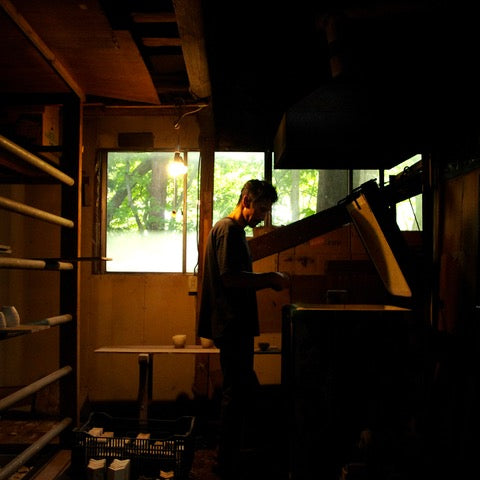
Today's Suzu ware artisans face a unique challenge: they are simultaneously inheriting an ancient tradition and pioneering its modern expression. They have no living masters—only fragments, kiln sites, and historical records to guide them. Yet through patient research and experimentation, they have successfully recreated the techniques and continue to produce pieces that honor the medieval originals while speaking to contemporary sensibilities.
The pieces created today maintain fidelity to the ancient methods while serving modern needs. You'll find traditional vessels alongside contemporary forms—all created using the same reduction-firing techniques that defined Suzu ware 800 years ago.
Why Suzu Ware Matters
Suzu ware represents resilience, cultural memory, and the enduring value of craftsmanship. It is a reminder that traditions can be lost—but they can also be recovered. The fact that a community chose to invest resources in reviving a forgotten art form speaks to something fundamental about human culture: our need to preserve, honor, and continue the work of those who came before us.
When you hold a piece of Suzu ware, you're holding evidence of this revival. You're participating in a living tradition that emerged from ash and memory, and continues to evolve in the hands of artisans committed to honoring both its past and its future.

コメントを書く
このサイトはhCaptchaによって保護されており、hCaptchaプライバシーポリシーおよび利用規約が適用されます。