記事: Artisan Profile: Fumito Abe

Artisan Profile: Fumito Abe
The Craftsman Who Found His Voice in Clay
Fumito Abe creates vessels that whisper rather than shout. Born in Nagano in 1975, his path to ceramics began not through academic success, but through the simple joy of making things—drawing as a child, then discovering in clay a lifetime's conversation with earth and fire.
A Journey Through Technique
After graduating from Hida International Craft Academy's ceramics program in 1996, Abe encountered Suzu ware and its deep, unglazed blackness. He spent nearly a decade in Suzu, following that attraction to materials with presence—the texture of fired clay, the suggestion of stone and sand embedded in earth. In 2005, he relocated to Aomori Prefecture, and in 2012, built his anagama (traditional wood-fired kiln) in Ajigasawa, where he continues today.
His shift from pure Suzu tradition to his current practice marks a quiet evolution: the introduction of urushi (lacquer) as a finishing medium on unglazed, fired clay—an approach that bridges Japanese ceramic and lacquer traditions.
Philosophy: The Vessel as Guest
Unlike glazed ceramics, Abe's vessels are finished with lacquer applied to raw, fired clay. The process is intentional but not controlling. He allows the clay's natural character—hairline cracks, flecks of stone (ishihaze)—to remain visible beneath the lacquer. This textured surface is sealed through a technique inspired by fukiurushi (wiped lacquer): lacquer is absorbed into the unglazed body as undercoat, then burnished into a subtle, water-resistant finish.
The result is a vessel that protects without hiding. Stone and cracks catch the light and memory. Water resists. The dish or bowl becomes a stage—one that honors rather than competes with food, flowers, or whatever it holds.
Why Ceramics? Why This Way?
Abe explains that he was never drawn to academic subjects, but the contemplative act of making—the steady, meditative practice—called to him early. In ceramics, he found both refuge and purpose. His work resists artifice. He doesn't chase effects; instead, he reveals what the material naturally offers. The cracks, the embedded stone (ishihaze), the way lacquer settles into texture—these are features, not flaws.
"I want this vessel to enhance your meal, your flowers, your moment," he says. "Not to demand attention, but to be a quiet, beautiful companion at your table."
The Vision Ahead: The Black That Breathes
Abe is drawn to a particular black—the deep, light-absorbing black of urushi lacquer. This black is unlike any ceramic glaze; it has a depth that seems to recede, creating a visual rest. Against this black, sake glows, food becomes precious, flowers gain weight.
His future work moves deeper into this territory: refining the black, exploring how his unglazed clay and lacquer technique can create vessels where the richness of food and drink is elevated by the vessel's own restraint.
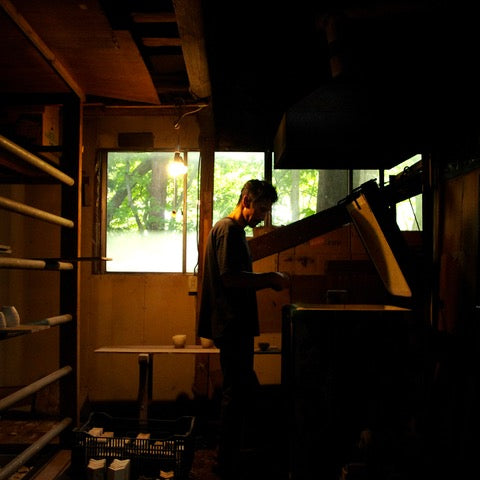
Fumito Abe's Studio
Ajigasawa, Aomori Prefecture, Japan
Anagama kiln, built 2012

コメントを書く
このサイトはhCaptchaによって保護されており、hCaptchaプライバシーポリシーおよび利用規約が適用されます。